
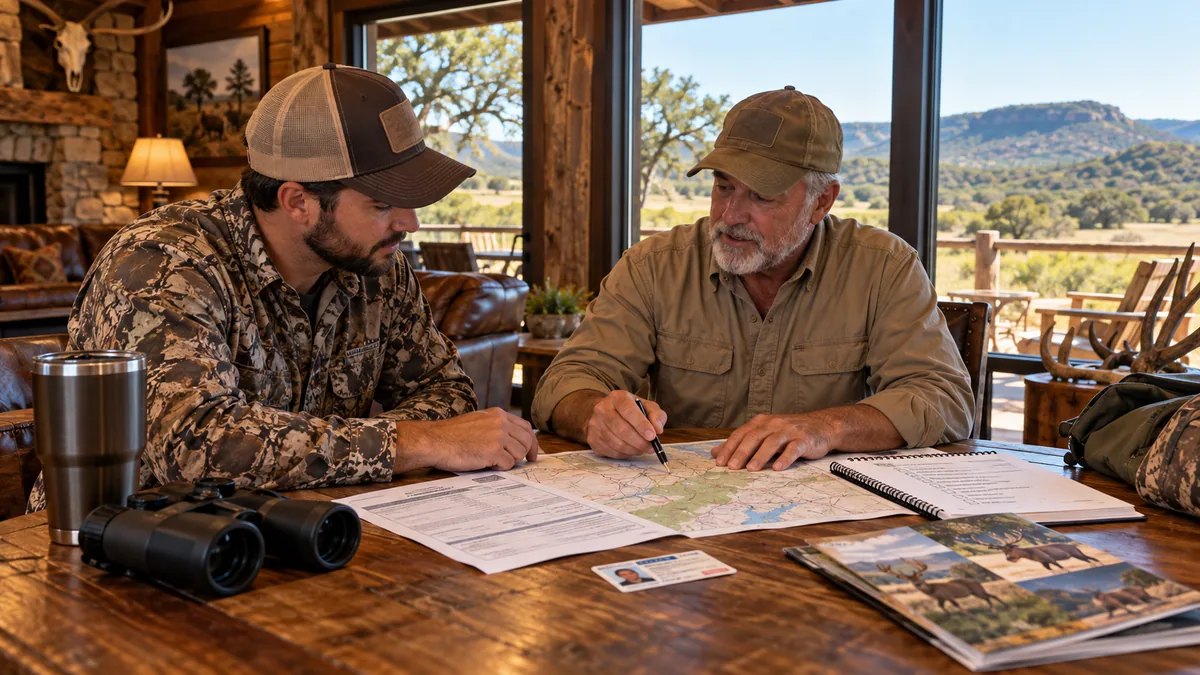

A Texas ranch hunt can feel refreshingly simple once you arrive: check in, meet your guide, settle into the lodge, and focus on the experience. The paperwork, however, still matters. A Texas exotic hunting license is required for hunters pursuing exotic game on private property, and the right license depends on residency, age, species, and the length of the trip.
That distinction is especially important at Squaw Mountain Ranch, where guests can choose among more than 30 native and exotic trophy species on more than 2,000 acres near Jacksboro. A hunter coming for axis deer, red stag, elk, sable, or another exotic may have a different licensing path from a nonresident who also plans to pursue native whitetail deer.
This guide is built around the Texas Parks and Wildlife Department (TPWD) rules in effect for the 2026–2027 license year, which runs from September 1, 2026 through August 31, 2027. Regulations and fees can change, so always verify the current TPWD Outdoor Annual before purchasing a license or traveling.
The Short Answer: Yes, Exotic Hunters Still Need a Texas Hunting License
Texas classifies animals such as axis deer, elk, sika deer, fallow deer, red deer, aoudad, and blackbuck as exotic because they are not indigenous to the state. On private property, Texas generally does not impose state closed seasons, bag limits, or possession limits on exotic animals. That flexibility is one reason exotic hunts in North Texas can be scheduled throughout much of the year.
But “no closed season” does not mean “no license.” TPWD states that a hunting license is required to hunt exotic animals, and the hunter must have the landowner’s permission. At a commercial hunting ranch, the property-access side is handled through your booked hunt, while the individual hunter remains responsible for having the correct personal license and any required hunter-education documentation.
Exotic Game and Native Whitetail Follow Different Rules
One of the most useful planning steps is deciding whether your trip is exotic-only or includes native game. Texas whitetail deer are native game animals and are subject to seasons, tagging rules, county regulations, and license restrictions that do not apply in the same way to exotic species.
| Hunt Type | Typical Example | Season Framework | License Planning |
| Exotic-only | Axis deer, red stag, elk, blackbuck | No state closed season on private property for exotics | Resident license or qualifying nonresident exotic license may work |
| Native deer | Whitetail deer | Season, tagging and county rules apply | Nonresident General Hunting License required for nonresident whitetail hunters |
| Mixed trip | Whitetail plus an exotic species | Both rule sets matter | Choose a license valid for every species on the itinerary |
Current 2026–2027 Texas Hunting License Options
The following prices are current in TPWD’s 2026–2027 Outdoor Annual. They are useful for trip budgeting, but confirm them again immediately before purchase.
Texas Resident Hunting License
The standard Resident Hunting License is $25 and is valid to hunt legal birds and animals, subject to any endorsements or species-specific rules that apply. For a Texas resident booking an exotic hunt, this is usually the starting point.
Nonresident Special 5-Day Small Game/Exotic License
For many out-of-state guests planning an exotic-only trip, the most important option is the Nonresident Special 5-Day Small Game/Exotic Hunting License (Item 157), currently $48. It is valid for five consecutive days and covers exotic animals along with certain other legal species.
The limitation is crucial: this five-day license is not valid for white-tailed deer or mule deer. It also does not cover wild turkey, alligator, pronghorn, or bighorn sheep. If your ranch itinerary includes whitetail, do not assume the $48 exotic license is enough.
Nonresident General Hunting License
For a nonresident hunting Texas whitetail deer, TPWD lists the Nonresident General Hunting License at $315. It is the nonresident license used for legal game including deer, with applicable endorsements and regulations. This is why confirming the exact species before buying a license can save both time and an unnecessary second purchase.
Youth Hunting License
A Youth Hunting License is $7 for residents and nonresidents under age 17 at the time of purchase. Youth rules also interact with hunter-education and accompaniment requirements, so families should review each young hunter individually rather than assuming the adult’s paperwork covers the group.
Hunter Education: The License Is Only Part of the Checklist
Texas requires every hunter, including out-of-state hunters, born on or after September 2, 1971 to successfully complete hunter education unless the person qualifies to hunt under an allowed accompaniment or deferral arrangement. Proof of certification or deferral must be carried while hunting, either in printed or accepted electronic form.
For hunters age 17 and older who have not completed hunter education, Texas offers a one-time Hunter Education Deferral for the current license year. A hunter using that deferral must be accompanied within normal voice control by a properly qualified hunter. The deferral is not a substitute for planning ahead, particularly for a private ranch trip with fixed dates.
Families booking family hunting trips in North Texas should check every participant’s birth date, certification status, and license separately before departure.
New Identification Rules Matter for 2026 Trips
Texas changed recreational license identification procedures in 2026. Effective August 3, 2026, individuals age 17 and older must satisfy new ID-validation requirements when obtaining recreational hunting or fishing licenses. TPWD notes that an unexpired REAL ID from a U.S. state or territory satisfies the identification requirement; online buyers must complete independent ID validation, and foreign residents are not eligible for online purchases.
That makes “I’ll buy my license the night before” a riskier plan than it used to be. If you are traveling from another state or country, complete the license process early enough to resolve an ID or account issue without affecting your hunt dates.
Private Property Gives Flexibility, Not an Exemption
TPWD’s exotic-species rules are notably flexible on private property: there are no state closed seasons, state bag or possession limits, or state-required means-and-method restrictions for exotic animals. A valid hunting license and landowner permission are still required.
For a guest at Squaw Mountain Ranch, that private-property structure supports year-round opportunities for many exotics, but the ranch’s own availability, animal selection, package structure, guide schedule, and ethical management practices still determine what can be booked. The current exotic hunt selection is the better place to start than assuming every species is available on every date.
What to Confirm Before You Buy Your License
Confirm the exact species. Axis deer and red stag are exotic; whitetail is native game. A mixed itinerary can change which nonresident license you need.
Confirm the hunt dates. The five-day nonresident exotic license covers five consecutive dates, so the selected window must match the actual hunt.
Check hunter education. Verify certification, exemption, accompaniment, or deferral requirements before travel.
Validate your ID early. Hunters age 17 and older should not leave the 2026 ID-validation process until arrival day.
Ask about any species-specific details. If your plan includes turkey or native deer, additional rules may apply beyond the exotic framework.
Save digital and printed copies. Keep your license, ID, hunter-education proof, booking confirmation, and emergency contact information accessible.
A Simple Pre-Trip Checklist for an Exotic Hunt Near Dallas-Fort Worth
7–14 days out: finalize species, hunt dates, lodging dates, and group size with the ranch.
7 days out: purchase the correct Texas hunting license and complete any ID validation.
Before travel: confirm hunter-education proof or an applicable deferral/accompaniment plan.
Before packing: ask the ranch which personal field gear you need and which equipment is already provided.
Arrival day: keep your license and identification with you rather than buried in luggage.
If plans change: recheck licensing before adding a native species or extending a hunt beyond the license window.
Squaw Mountain Ranch’s all-inclusive structure means meals, lodging, guide services, stands, blinds, and other field support are built into the experience. Its ranch lodging near Dallas-Fort Worth includes six private guest cabins and a central lodge, which simplifies travel logistics—but the hunting license itself remains the hunter’s responsibility.
Plan the Paperwork First, Then Enjoy the Ranch
A Texas exotic hunting license is not complicated once you separate exotic-only hunts from native-game hunts. The biggest mistakes usually come from buying a license before the species list is final, assuming private-property exotics are license-free, or using the five-day nonresident exotic license for a whitetail hunt it does not cover.
If you are considering an axis, elk, red stag, sable, or another exotic hunt in North Texas, start by discussing the species and dates with Squaw Mountain Ranch. Once the itinerary is clear, match it to the current TPWD rules and arrive ready for the part of the trip you actually came for—the ranch experience.
Authoritative References
Texas Parks & Wildlife — Nongame, Exotic, Endangered, Threatened & Protected Species
Texas Parks & Wildlife — Hunting Licenses
Texas Parks & Wildlife — Hunter Education
Texas Parks & Wildlife — License Purchase Requirements
Regulations, fees, and eligibility rules can change. This article is educational and is not legal advice. Verify current requirements with Texas Parks & Wildlife before purchasing a license or hunting.